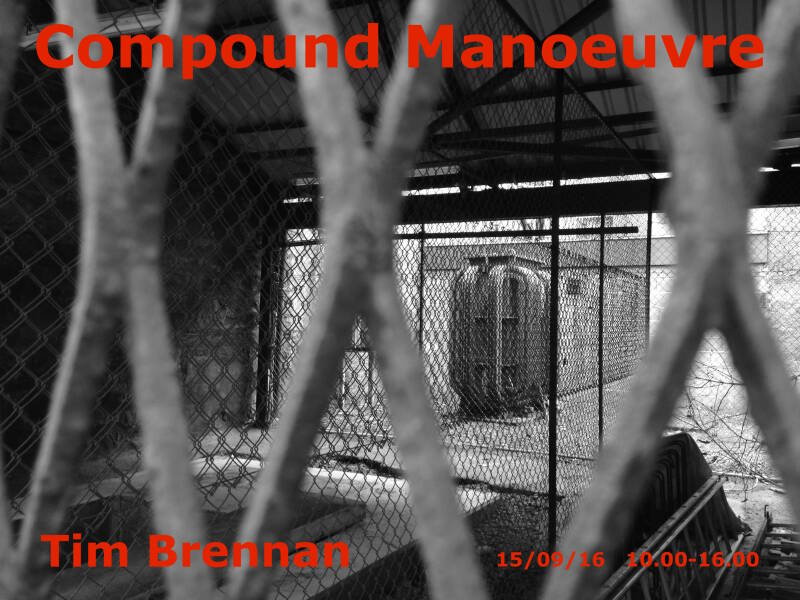
Compound Manoeuvre
Massey University, Wellington, New Zealand
15 September 2016
Introduction
Compound Manoeuvre was a six-hour durational performance undertaken whilst Professor of Art at Massey University, Wellington. Throughout the day I repeatedly walked the perimeter of the postgraduate courtyard carrying a long wooden staff surmounted by the carved head of a fox.
Students had been invited in advance to join the walk for as much or as little of the duration as they wished. Participation was entirely voluntary, creating a series of temporary encounters within an otherwise continuous procedure.
Institution as Medium
Although structured as a Manoeuvre, the work is situated within the institutional strand of my practice. The performance occupied the enclosed courtyard at the centre of the former Dominion Museum building, home to Massey's postgraduate programme. Before the museum was constructed, the site formed part of Mount Cook Prison. The courtyard therefore became a place in which the histories of prison, museum and university converged, allowing the work to address discipline, pedagogy and institutional authority through a single sustained action rather than through representation.
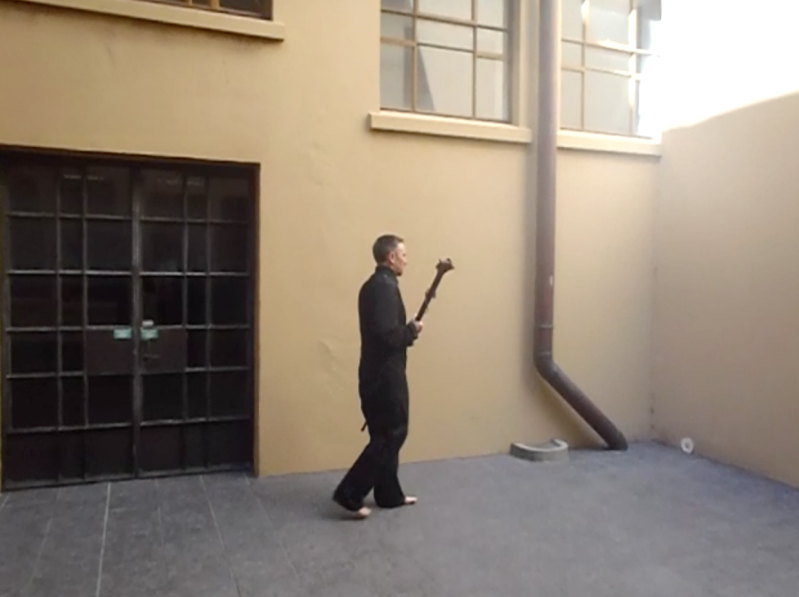
The police overall was chosen deliberately. Rather than adopting the role of either prisoner or police officer, the work occupied an ambiguous position between authority and submission. Michel Foucault's Discipline and Punish, a text that has accompanied my teaching and research for more than four decades, provided an important conceptual backdrop to the performance. The repeated circuit of the courtyard echoed the regulated movement of institutional space whilst simultaneously transforming it into a site of reflection, encounter and duration.
The Fox
The fox emerged from an unexpected source. During my interview for the Professorship at Massey I was asked, "If you were an animal, which would you be?" My answer was immediate: a fox. Foxes manoeuvre. They survive by adaptation rather than domination, moving through environments that are not naturally their own.
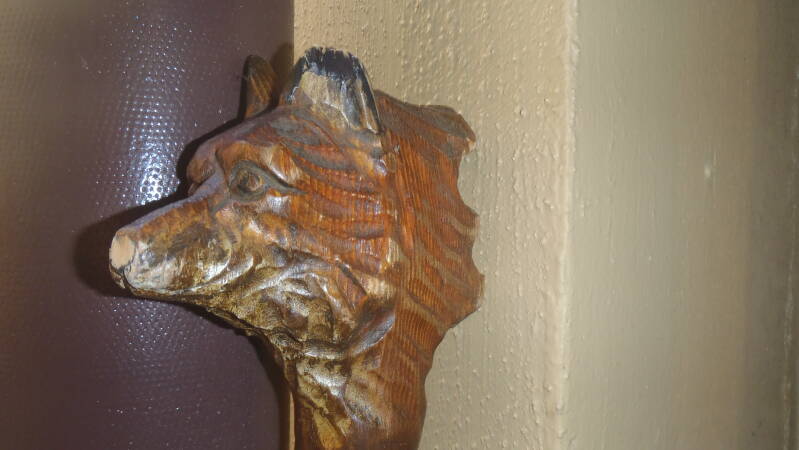
Academia has often felt such a territory. Unlike Joseph Beuys' coyote, the fox inhabits both city and countryside, crossing boundaries between the institutional and the everyday. Significantly, there are no foxes in New Zealand. Throughout the performance I became, in both a literal and symbolic sense, the only fox present.
The Wand
The carved fox-headed staff functioned not simply as a walking stick but as a wand. Traditionally the wand signifies authority, guidance or specialised knowledge. Here, however, it remained open to others. During the performance participants were invited to hold the staff, at times guiding me whilst I walked with my eyes closed. Authority therefore became shared rather than possessed. The work proposed a pedagogy founded not upon transmission from expert to novice but upon the temporary redistribution of responsibility, trust and attention.
Percipiation
Students were invited to enter and leave the performance at any point during the six hours. There was no expectation that they should remain, nor any prescribed form of engagement. Some walked silently, others conversed briefly, while several simply observed before moving on. The performance remained structurally complete whether accompanied or alone. What mattered was not participation as such, but the possibility of percipiation: the shared condition of attention through which performer, participant and site might momentarily enter into relation.
One MFA student percipient (Isla Griffin-Wilson) later described the courtyard as simultaneously recalling an exercise yard, a place of confession and a site of sustained attention before taking hold of the fox-headed wand to guide the performance through the space. Their account documents not the work itself so much as an encounter with its conditions.
Encounter
(Isla Griffin-Wilson)
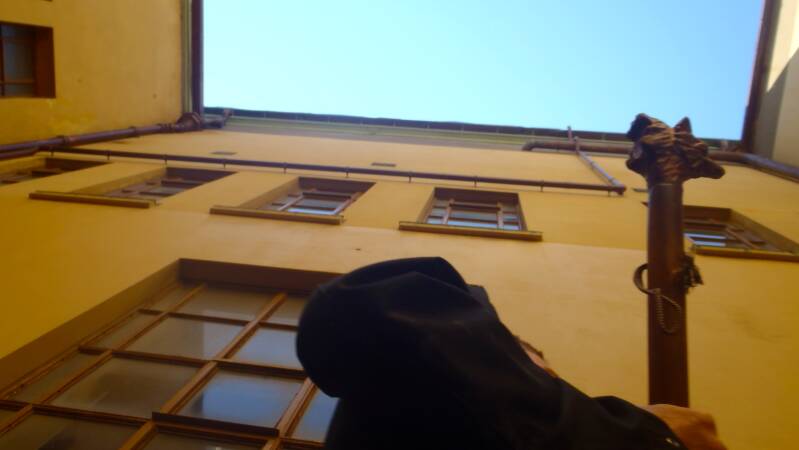
There was a burdensomeness to the walker, stripped of identity with a black cloth overall carrying a stick. A heavy looking, long, hand-carved staff with a fox head. The fox, quick and witty, cunning and slippery – a counterpoint to the weight of the walker... The sky is so cleanly blue today. I lay on the floor to capture the sky above his head as he walked. It seemed important
The No.1, almost, shaved head engages the idea of this place as an old prison. The enclosed space an exercise yard. Yet there is nothing penal about this. It feels religious. A place of confession, of being listened to without retort or judgment... in parallel with a monkish aura there is a mild stubbornness aimed at the task...
I suggest that he close his eyes... I grab one end of the stick. We hold it horizontal. Four hands lightly holding what becomes a directional tool. Guidance by light pressure. We get back to the path as the dark interior envelopes him...
Conclusion
I felt in the end my presence became about trying to lighten his load in different ways. Energetically, psychologically and materially... How can I know anything of his interiority. I don't. I know nothing.
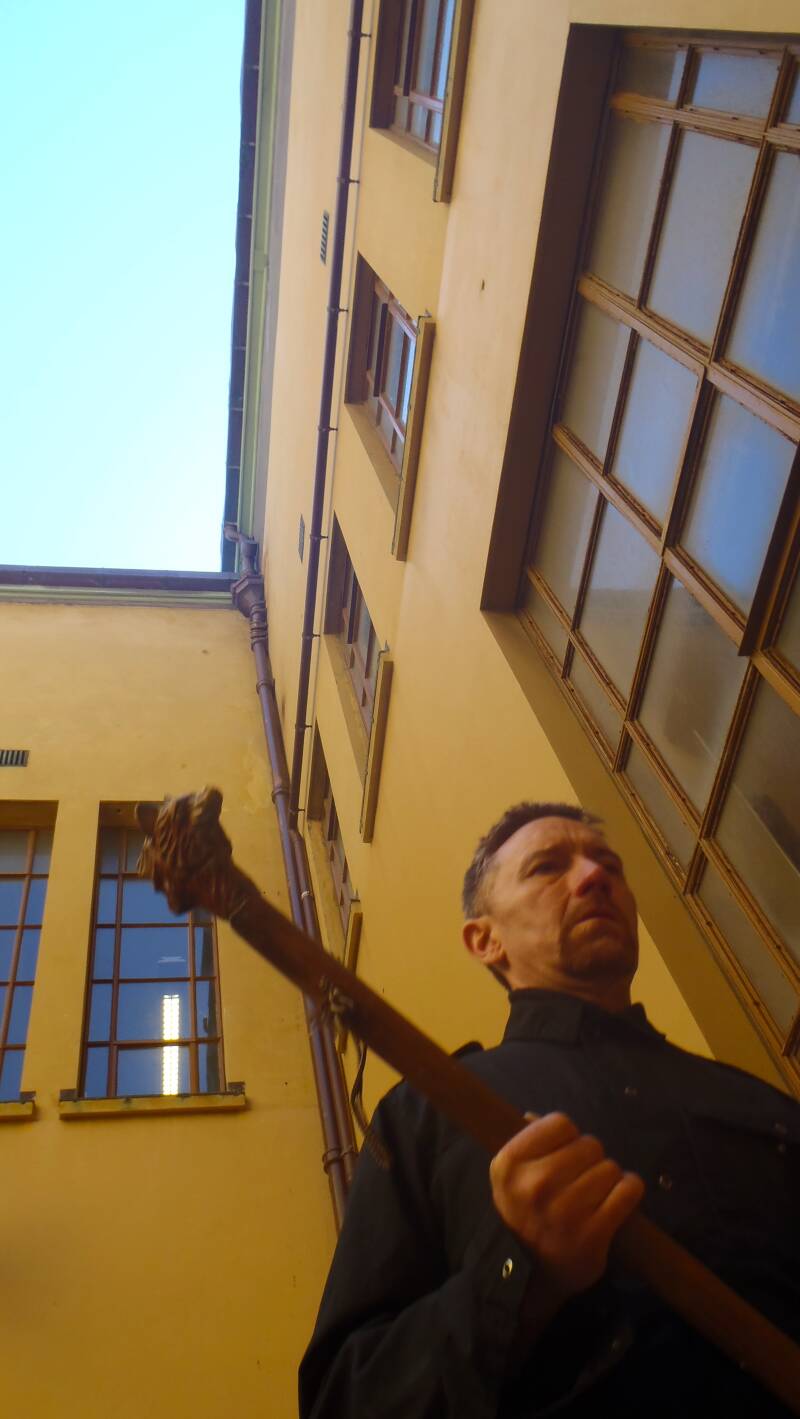
The performance therefore remained structurally complete whether accompanied or alone. These contingent encounters became moments in which teaching, conversation, companionship and shared attention emerged through walking rather than through formal instruction.
Looking back, Compound Manoeuvre represents a convergence of several longstanding concerns within my practice: the Manoeuvre as procedural form, the institution as site and medium, and pedagogy understood as the creation of conditions rather than the prescription of outcomes.
Create Your Own Website With Webador